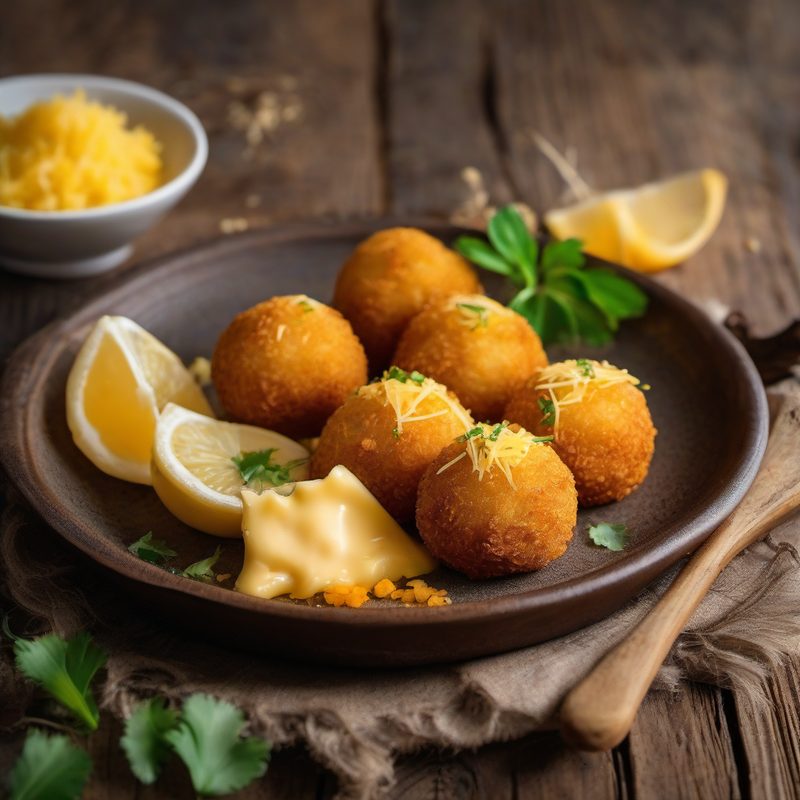
Sicilian Rice Arancini
The pride of Sicilian street food — golden, crispy rice balls stuffed with a slow-simmered meat ragù, peas, melted caciocavallo, prosciutto, and mozzarella, fried until shatteringly crisp.
| Amount | Ingredient |
|---|---|
| 1 lb (500 g) | Vialone Nano rice |
| 1 | saffron sachet |
| 4¼ cups (1.2 L) | water |
| 2 oz (55 g) | butter |
| 3½ oz (100 g) | aged caciocavallo, grated |
| fine salt, black pepper | |
| For the ragù filling | |
| ½ | onion |
| 3½ oz (100 g) | ground pork |
| ½ cup (50 g) | butter (for the soffritto) |
| ¾ cup (200 ml) | tomato passata |
| 2¾ oz (80 g) | tiny peas (pisellini) |
| ¼ cup (50 ml) | red wine |
| extra-virgin olive oil | |
| For the stuffing and coating | |
| 1¾ oz (50 g) | fresh caciocavallo, cubed |
| 1 oz (30 g) | cooked ham (prosciutto cotto), one thick slice |
| 2 oz (60 g) | mozzarella, cubed |
| 1¾ cups (200 g) | all-purpose flour |
| 1¼ cups (300 ml) | water (for the batter) |
| breadcrumbs, frying oil |
Arancini are Sicily's most beloved street food: compact timbales of saffron rice, hollowed and filled with a rich meat ragù, then sealed, breaded, and fried to a deep golden crisp. The secret is cooking the rice so it absorbs all its water — dry and compact, so the starch stays in the pot and the balls hold together. Inside, molten mozzarella and cubes of caciocavallo wait to pull into strings. They take time and patience, and they're worth every minute.
Ingredient notes: Vialone Nano is the classic arancini rice — it absorbs water completely and stays compact. Caciocavallo is a stretched-curd cheese; aged for grating, fresh for melting. If unavailable, use aged provola for grating and a mild provola for the cubes. The ragù must be thick, not soupy, or the arancini will leak.
- Large pot (for the rice)
- Wide baking tray
- Skillet (for the ragù)
- Plastic wrap
- Deep pot or fryer (for frying)
- Bowl of water (for wetting hands)
- Slotted spoon
- Cook the rice (15 min). Boil the rice in 1.2 L of salted water, cooking about 15 minutes until all the water is absorbed — the rice must be very dry and compact.
- Season the rice (5 min). Dissolve the saffron in a little hot water and stir into the rice with the butter and grated caciocavallo. Mix well.
- Cool the rice (2 hr). Spread the rice on a wide, shallow tray, cover with plastic wrap (so the surface doesn't dry), and let it cool completely — at least 2 hours at room temperature.
- Make the ragù (30 min). While the rice cools, finely slice the onion and stew it in a pan with 2 tbsp oil and butter. Add the ground pork and brown over lively heat, then deglaze with the red wine. Add the tomato passata, season, cover, and simmer at least 20 minutes. Halfway through, add the peas. The ragù must be thick, not liquid.
- Prep the stuffing (10 min). Cut the caciocavallo, cooked ham, and mozzarella into small cubes.
- Shape the arancini (20 min). Keep a bowl of water nearby and wet your hands. Take about 2 tbsp (120 g) of rice, press a hollow in the palm, fill with a spoonful of ragù and a few cheese and ham cubes, then seal with more rice, shaping into a ball.
- Batter and bread (10 min). Whisk the flour with 300 ml of water into a thin batter. Dip each arancino in the batter, then roll in breadcrumbs until well coated.
- Fry (5-7 min per batch). Heat frying oil to 340°F (170°C) and fry the arancini in batches until deep golden and crisp. Drain on paper towels and serve hot — the cheese should pull into strings.
- Dry, compact rice is non-negotiable. All the water must be absorbed so the starch stays in the pot — that's what holds the balls together.
- Cool completely. Two hours minimum; warm rice falls apart when shaped.
- Thick ragù, not soupy. A liquid filling makes the arancini burst in the fryer.
- Wet hands. Water prevents the rice from sticking as you shape the balls.
- Batter + breadcrumbs. The double coating is what gives that shattering crust.
- Fry at 340°F (170°C). Too hot burns the crust before the center warms; too low makes them greasy.
| Mistake | Why It Hurts | The Fix |
|---|---|---|
| Rinsing the rice | Washes away the starch | Never rinse — the starch binds the balls |
| Warm rice when shaping | Falling apart | Full 2-hour rest |
| Soupy ragù | Leaking, bursting arancini | Simmer until thick and dense |
| Skipping the batter | Thin, patchy crust | Batter + breadcrumb double coat |
| Oil too hot | Burnt outside, raw inside | 340°F (170°C), moderate batches |
| Overcrowding the pan | Dropping temperature, greasy balls | Fry in small batches |
- Classic Butter Version: Add a cube of butter in the center of each ball.
- Vegetarian Arancini: Fill with spinach and mozzarella, or just ragù-free cheese.
- Pistachio Arancini: The modern Catania favorite — dip in pistachio crumbs.
- Al Forno: Bake at 400°F (200°C) for 20 minutes instead of frying.
- Norma Style: Fill with fried eggplant, tomato, and ricotta salata.
| Storage Method | Details |
|---|---|
| Refrigerator | Store fried arancini in an airtight container for up to 3 days. |
| Freezer | Freeze uncooked (or fried) for up to 3 months; fry from frozen, adding a few minutes. |
| Reheating | Reheat in a 375°F (190°C) oven for 10 minutes to restore crispness — not the microwave. |
Sicilian street food pairs beautifully with:
- Nero d'Avola — Sicily's great red, full and fruity.
- Grillo — Crisp white with citrus bite.
- Prosecco — Bubbles cut the fried richness.
- Peroni or Sicilian beer — The authentic street-food pairing.
| Per Serving (1 of 12 arancini) | |
|---|---|
| Calories | 320 |
| Protein | 11 g |
| Fat | 14 g |
| Carbohydrates | 37 g |
| Fiber | 2 g |
Nutrition values are approximate and will vary with brand choices and substitutions.
What does "arancini" mean?
"Little oranges" — named for their shape and golden color. In eastern Sicily they're often cone-shaped (arancine), in the west round.
Can I make them ahead?
Yes — shape and bread them, then refrigerate up to a day or freeze for months. Fry just before serving.
What if I can't find caciocavallo?
Use provola (aged for grating, mild for melting) or a good mozzarella for the filling.
Why is the rice cooked without rinsing?
The surface starch is the glue — rinsing washes it away and the arancini won't hold together.
Are they served with sauce?
Traditionally no — they're eaten by hand, hot from the fryer, often with a little lemon.
- Rice Croquettes with Provola and Ham (Volume 3)
- Baked Rice with Peas, Eggs and Smoked Scamorza (Volume 3)
- Saffron Risotto (Volume 3)
Recipe from "The Italian Kitchen" by Vita Milanese — Volume 3: Risotto & Rice
Recipe from The Italian Kitchen by Vita Milanese — Volume 3 · Risotto & Rice. Discover all volumes on the ebook page.