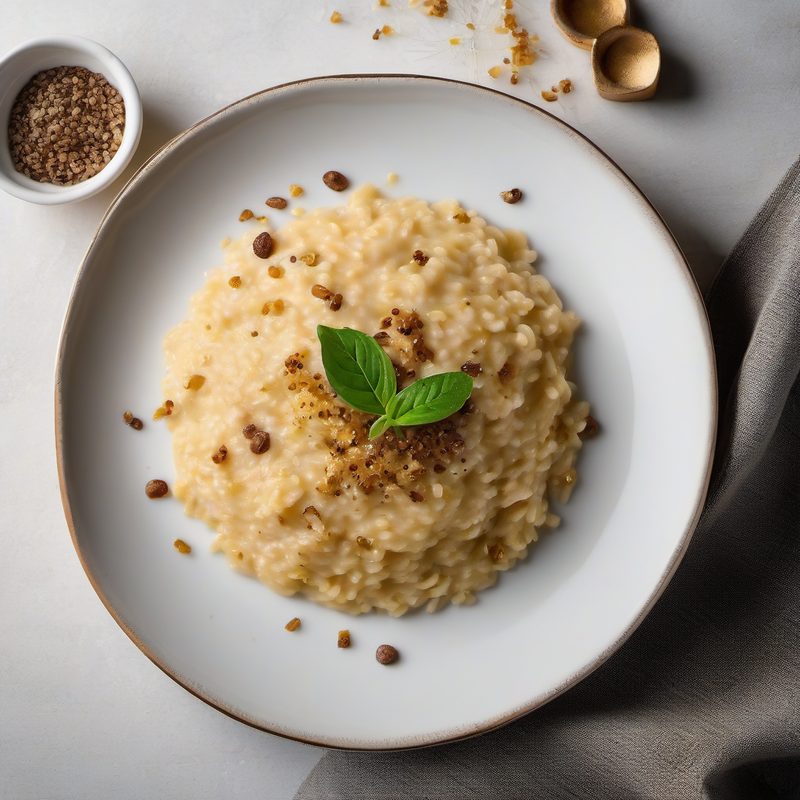
Carbonara Risotto
The Roman Carbonara reborn as risotto — guanciale, Pecorino Romano, egg yolks, and black pepper — where the crucial technique is adding the egg mixture off the heat, letting residual heat create a glossy emulsion without scrambling the yolks.
| Amount | Ingredient |
|---|---|
| 11¼ oz (320 g) | Carnaroli rice |
| 4 cups (1 L) | light chicken or vegetable stock, kept hot |
| 4¼ oz (120 g) | guanciale, cut into 8 mm strips |
| 2¾ oz (80 g) | Pecorino Romano, finely grated |
| 4 | egg yolks (about 2½ oz / 70 g), at room temperature |
| ¾ tsp (4 g) | black peppercorns, coarsely crushed |
| ½ tsp (3 g) | fine sea salt, plus more as needed |
| For finishing | |
| ¾ oz (20 g) | Pecorino Romano, finely grated |
| ¼ tsp (1 g) | black pepper, freshly ground |
This is Carbonara translated into rice: guanciale rendered slowly from a cold pan until golden and crisp, rice toasted in the rendered fat with black pepper, and a Carbonara cream of egg yolks, Pecorino, warm stock, and crispy guanciale folded in completely off the heat. No wine, no cream, no butter — the richness comes from guanciale fat, yolks, Pecorino, and the rice's own starch. Golden, glossy, and unmistakably Roman.
Ingredient notes: Guanciale is cured pork jowl — the true Roman ingredient; pancetta is the closest substitute. The egg yolks must be at room temperature. Because Pecorino and guanciale are already salty, keep the stock only lightly seasoned. There is no wine and no butter in this version — by design.
- Wide pan (for the guanciale and rice)
- Slotted spoon
- Small bowl (for the Carbonara cream)
- Whisk
- Wooden spoon
- Ladle
- Warm serving plates
- Render the guanciale (6-8 min). Place the guanciale in a cold, wide pan. Set over medium-low heat and cook 6-8 minutes — the fat should render slowly while the guanciale becomes golden and crisp. Starting cold lets the fat render gradually before the exterior darkens. Remove the crispy guanciale with a slotted spoon and reserve. Keep about 1 oz (30 g) of the rendered guanciale fat in the pan.
- Toast the pepper (30-45 sec). Add the crushed black pepper to the guanciale fat and toast until fragrant.
- Toast the rice (2 min). Add the Carnaroli and toast about 2 minutes, stirring continuously. Do not add wine — Carbonara traditionally contains none, and its acidity would distract from the egg, Pecorino, guanciale, and pepper.
- Cook the risotto (14-16 min). Add enough hot stock to barely cover the rice. Cook at a gentle simmer, gradually adding stock as it is absorbed, for 14-16 minutes. Keep the stock lightly seasoned.
- Make the Carbonara cream (3 min, parallel). While the rice cooks, combine the egg yolks, 80 g of Pecorino, 20-30 ml of warm stock, and about one-third of the crispy guanciale. Whisk until thick and smooth — the stock should be warm, not boiling. Gently tempering the yolks makes the final emulsification easier and reduces the risk of scrambled egg.
- Mantecatura (2 min). When the rice is al dente, leave it slightly more fluid than usual. Remove the pan completely from the heat and wait 45-60 seconds. Add the egg and Pecorino mixture while stirring vigorously, adding a little warm stock if necessary. The residual heat should thicken the yolks into a silky sauce without visibly coagulating them — glossy and all'onda.
- Plate (2 min). Divide immediately between warm, flat plates. Finish each serving with the crispy guanciale, Pecorino Romano, and freshly ground black pepper. Keep the presentation minimal — the golden risotto, dark pepper, and crisp guanciale provide all the contrast needed.
- Never return the pan to high heat after adding the yolks. Egg yolk proteins coagulate rapidly as temperature rises — the residual heat does the work.
- Cold pan for the guanciale. The fat renders gradually before the exterior darkens — that's the crispness.
- No wine, by design. Its acidity would distract from the egg, Pecorino, guanciale, and pepper.
- Temper the yolks first. Warm (not boiling) stock whisked in makes the final emulsification easy.
- No cream, no butter. Richness comes from guanciale fat, yolks, Pecorino, and rice starch.
- Keep the stock light. Pecorino and guanciale are already salty.
| Mistake | Why It Hurts | The Fix |
|---|---|---|
| High heat after the yolks | Scrambled egg | Off the heat, 45-60 sec wait |
| Boiling stock into the yolks | Coagulated cream | Warm, not boiling |
| Hot pan for the guanciale | Dark outside, raw inside | Start cold, medium-low |
| Adding wine | Distracts from the Carbonara | No wine in this recipe |
| Cream or butter | Muddies the Roman character | Guanciale fat + yolks + Pecorino |
| Salted stock | Too salty overall | Lightly seasoned stock only |
- Pancetta Version: Substitute pancetta for guanciale.
- Spicy Carbonara: A pinch of chili flakes with the pepper.
- Parmigiano Twist: Half Parmigiano, half Pecorino for a milder salt.
- Truffle Carbonara: Shave black truffle over the top.
- Zucchini Carbonara: Fold in sautéed zucchini ribbons.
| Storage Method | Details |
|---|---|
| Refrigerator | Leftovers can be refrigerated promptly and used within 1 day. |
| Freezer | Not recommended — the gently cooked yolks don't freeze well. |
| Reheating | Reheat thoroughly rather than attempting to recreate the original creamy consistency. |
This Roman classic pairs with:
- Frascati Superiore — The wine of the Roman hills.
- Grechetto — Crisp and mineral.
- Vermentino — Fresh and saline.
- Cesanese — A light Roman red.
| Per Serving (about 1¼ cups) | |
|---|---|
| Calories | 580 |
| Protein | 20 g |
| Fat | 22 g |
| Carbohydrates | 72 g |
| Fiber | 1 g |
Nutrition values are approximate and will vary with brand choices and substitutions.
Why add the egg mixture off the heat?
Egg yolk proteins coagulate rapidly as temperature rises. The residual heat of the risotto gently thickens the mixture while the fat, cheese, starch, and yolks emulsify into a creamy sauce.
Why no wine in this risotto?
Carbonara traditionally contains no wine — its acidity would distract from the combination of egg, Pecorino, guanciale, and pepper.
Is there cream or butter?
No — by design. The richness comes from guanciale fat, egg yolks, Pecorino, and the natural starch released by the Carnaroli.
Why keep the stock lightly seasoned?
Pecorino and guanciale are already salty — a seasoned stock would push the dish over the edge.
Can I prepare it in advance?
No — Carbonara risotto should be eaten immediately because it contains gently cooked egg yolks.
- Supplì alla Carbonara (Volume 3)
- Cacio e Pepe Risotto — Silky Pecorino Method (Volume 3)
- Risotto alla Salsiccia (Volume 3)
Recipe from "The Italian Kitchen" by Vita Milanese — Volume 3: Risotto & Rice
Recipe from The Italian Kitchen by Vita Milanese — Volume 3 · Risotto & Rice. Discover all volumes on the ebook page.